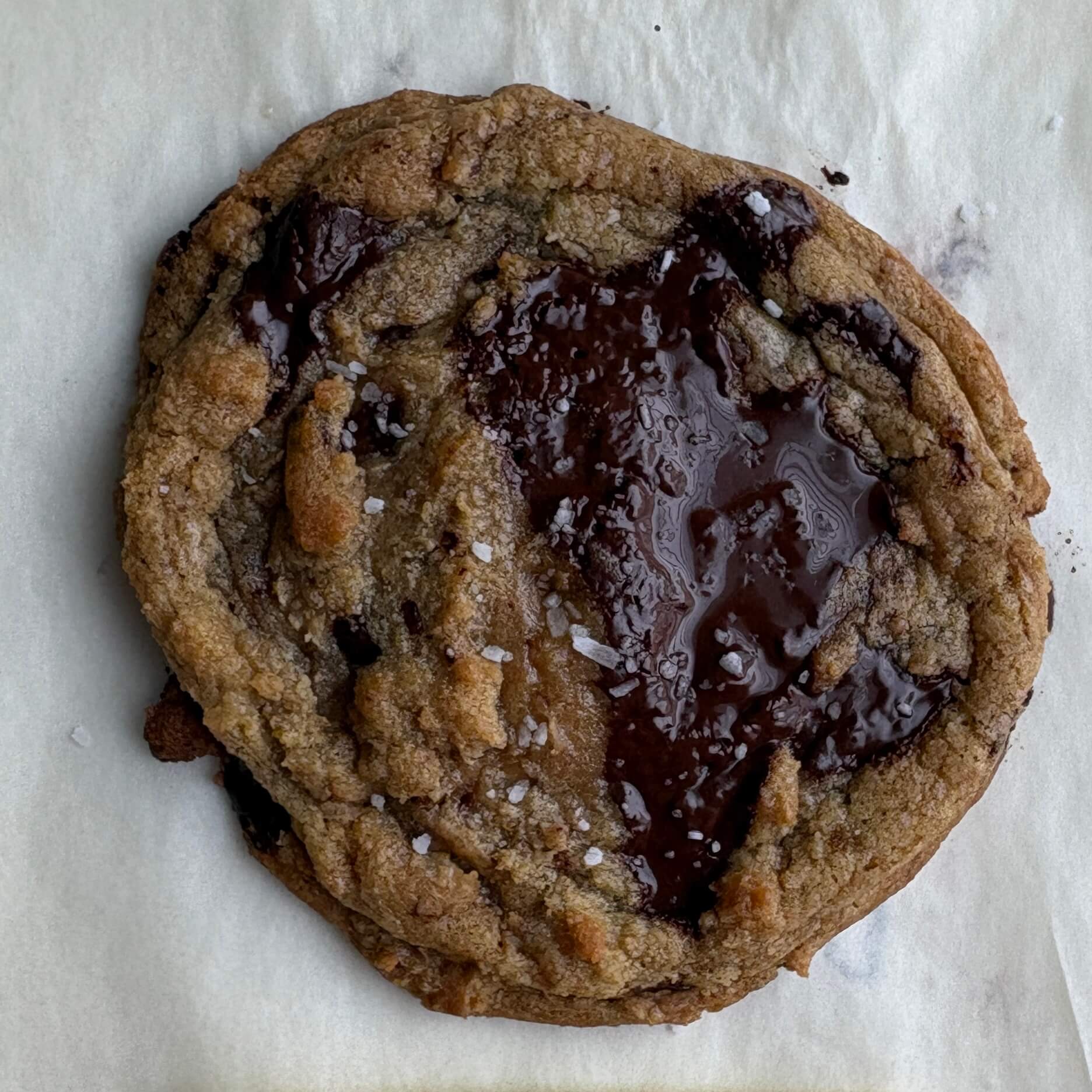
Trying to Make My Ultimate Chocolate Chip Cookies | Recipe Test
I love chocolate chip cookies. I mean, who doesn't? (If you don't, that’s a bit odd). I’ve been making them for years. The first time I made them from scratch by myself, I was in elementary school—maybe seven or eight years old. I remember borrowing a massive kids’ baking book from the school library and, left alone in the kitchen, attempting their chocolate chip cookie recipe.
The only issue was that I hadn’t learned fractions just yet. When I read "1 and 3/4 cups of flour," I thought I had to add the 1 and the 3 together... so I added four cups of flour. Let’s just say they were very, very floury cookies.
I’ve come a long way since then. Chocolate chip cookies are now second nature to me. Around 2020, right when COVID hit, I discovered Bon Appétit’s "Best Chocolate Chip Cookie" recipe by Chris Morocco. That was my first experience browning butter, and the recipe was so dependable that it quickly became my go-to. I love those cookies, but are they my ultimate recipe? I’m not so sure.
So, what’s a baker to do? It’s time for more recipe testing. This time, I’m diving deeper into the science of it all. I used to not be into the science at all, but lately, it’s become fascinating. Understanding the chemistry gives meaning and backing to every decision made in the dough.
I want to test this again and again until I get it right for myself. I know my "ultimate" cookie won't be the same as every other blogger or baker on the internet, and that is totally okay. So, come along for Recipe Test #1!
Choosing Between Methods
From my research, there are three main methods for bringing chocolate chip cookies together-specifically, methods used to create the sugar-lipid-protein structure of a cookie.
Method 1: Creaming This is the traditional way to make chocolate chip cookies, especially in professional bakeries. Sugar and room-temperature butter are creamed together, and the chemistry behind it is actually pretty cool: the sugar aerates the butter by carving small air pockets into the fat. When these pockets are heated in the oven, they expand! This produces a soft, pillowy cookie fresh out of the oven, but due to the instability of the emulsion, the cookie can become hard quite soon after baking.
Method 2: Egg Foaming In this method, the sugar is whisked with the eggs before liquid butter is introduced to the mix. This creates a stable protein structure from the eggs and sugar that traps small air bubbles. An emulsion is then formed when the butter is streamed in. Two advantages of this method are that the cookie has less "grease spillage"—because the proteins are pre-stabilized, there isn't as much fat leaking out—and you get a shiny, crackly crust on top with a thicker, uniform, and somewhat pillowy texture.
Method 3: Toffee This method involves whisking sugar into lukewarm browned butter, followed by the eggs. This creates a kind of loose, partial caramel as the sugar partially dissolves into the brown butter. The result is a cookie that is dense, chewy, and very brown-butter and butterscotch forward.
The Verdict The toffee method was my go-to, based on Bon Appétit’s recipe, but it wasn’t perfect. Dare I say something can taste too much like butter? The cookie is very brown-butter forward, which is delicious but can feel a little heavy. Also, since a type of caramel is formed, the cookie becomes quite hard after 24 hours or so, requiring reheating in a microwave to regain any softness.
The creaming method feels a little too basic and, in my experience, never produces anything truly satisfactory. So, I decided to try the egg foam method with a few adjustments. The most prominent recipe utilizing this method is by The Food Lab’s J. Kenji López-Alt. He uses more granulated sugar than brown sugar, whisking the granulated sugar with the eggs before adding the brown butter and then the brown sugar. I wanted my cookies to have a higher ratio of brown sugar to granulated sugar without compromising the initial egg-sugar protein structure. To achieve this, I whisked a portion of the brown sugar in with the granulated sugar and eggs, adding the rest afterward.
Below is a table of the final ingredient amounts and their baker’s percentages.
| Ingredient | Mass (g) | Baker’s % | Technical Role |
|---|---|---|---|
| All-Purpose Flour | 210g | 100% | Structural Base |
| Brown Sugar | 160g | 76.2% | Hygroscopy & Maillard flavor |
| Granulated Sugar | 50g | 23.8% | Crisp edges & meringue top |
| Unsalted Butter | 170g* | 80.9% | Tenderizer & flavor |
| Whole Egg | 50g | 23.8% | Structure & hydration |
| Egg Yolks | 36g | 17.1% | Emulsification (Lecithin) & richness |
| Chocolate | 185g | 88.1% | Inclusion density |
| Kosher Salt | 4g | 1.9% | Flavor enhancement |
| Baking Soda | 4g | 1.9% | Leavening |
I made the cookie dough and let it rest for around 20 hours in the fridge. I then wanted to test some baking temperatures and times, plus the temperature of the dough at the time of baking. Here are my tests below!
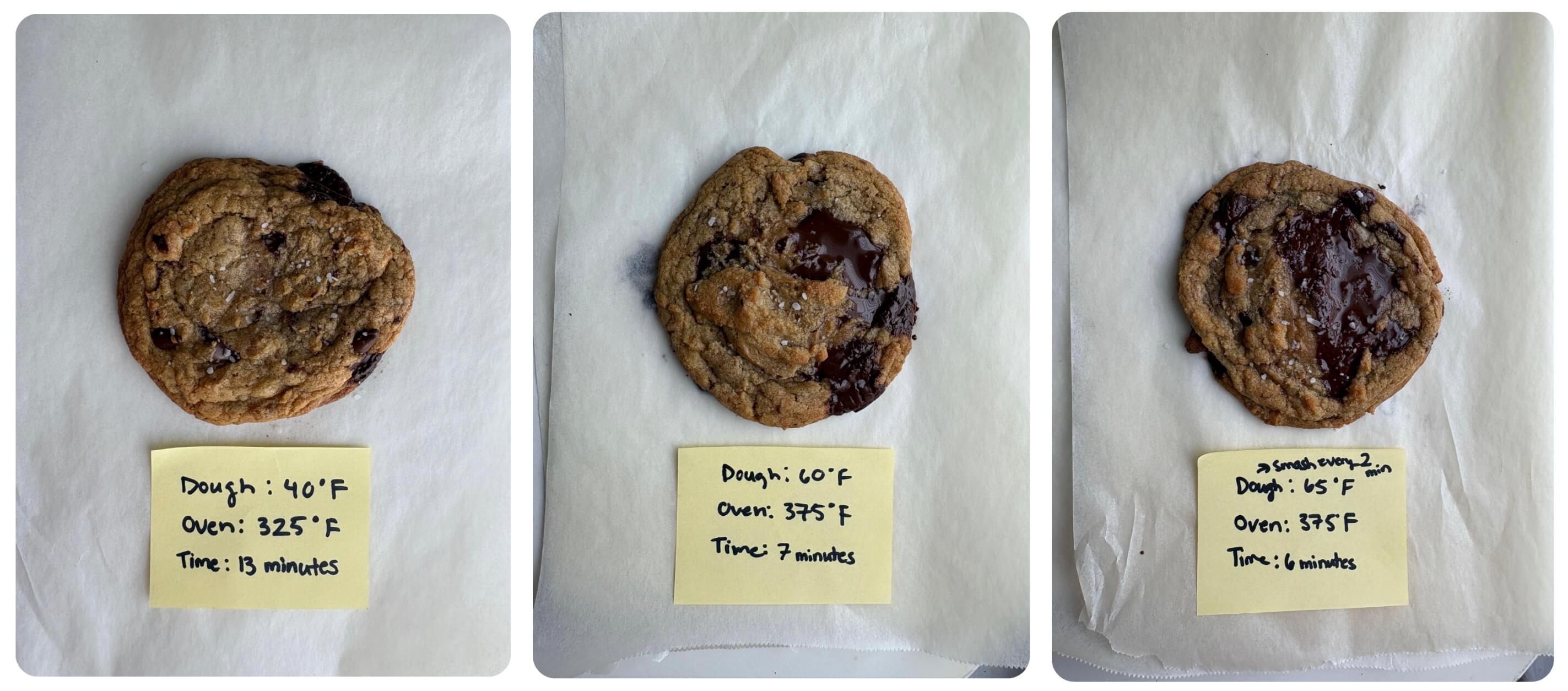
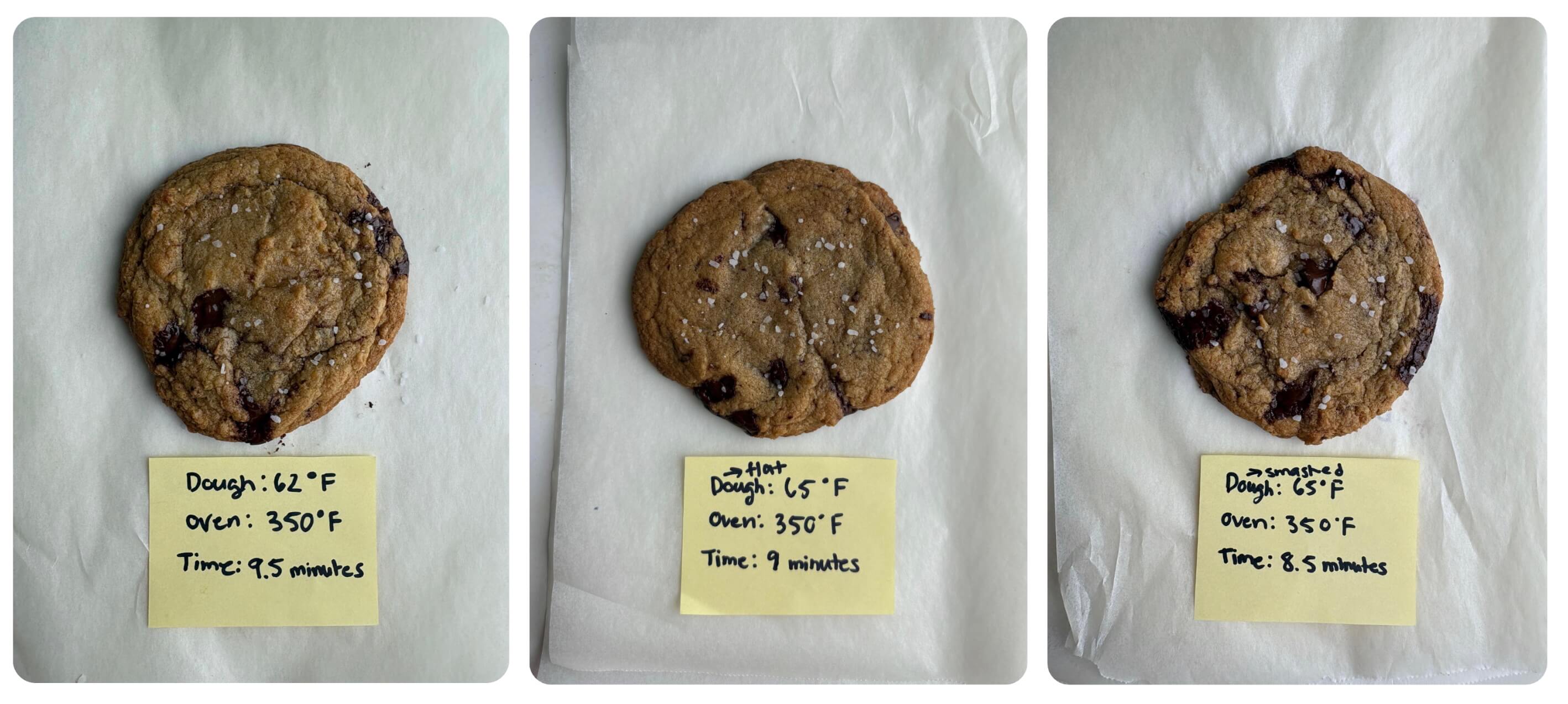
After baking each cookie and doing taste tests, here are some final ratings.
| Dough Temp (°F) | Oven Temp (°F) | Time (min) | Special Things | Description | Rating (1-5) |
|---|---|---|---|---|---|
| 40°F | 325°F | 13 | - | Slightly cakey, cakey flavor that wasn't as rich (a lot of nothing) | 1 |
| 62°F | 350°F | 9.5 | - | Less cakey, richer flavor, more "golden" and didn't have weird cakey flavor | 4 |
| 65°F | 350°F | 9 | Flattened dough into 3/4 inch disc before baking | Dry, airy, harder, like a Tate cookie | 1 |
| 65°F | 350°F | 8.5 | Smashed halfway through baking | Reallyyyy good, very gooey, feels great and awesome | 5 |
| 60°F | 375°F | 7 | - | More dry, soft moistness, but has more dry crunchy crust | 3 |
| 65°F | 375°F | 6 | Smashed every 2 minutes | Underbaked underneath but the top was golden and would have burned | 3 |
This was NOT a controlled experiment, haha. There were so many variables that I can't really make any great final revelations. But I will say that I thought the best results were baked at 350°F, and that this method is promising. The other really great positive was that even after 24 hours, these cookies were still very soft.
I don't think I will write the full recipe for this, but just know that your favorite baker will continue to work on this development. I want to do a direct side-by-side of this with my go-to recipe, with some other outside taste testers helping me. But I will admit that these cookies were quite delicious, for sure a really great first attempt at trying to figure this out!
Comments & Notes
Be the first to leave a note!